
CPTSD, CPTSI OR CPTSR?
DISORDER, INJURY OR RESPONSE?
You may have seen Complex PTSD referred to as Complex Post-Traumatic Stress Disorder (CPTSD), Complex Post-Traumatic Stress Injury (CPTSI) or Complex Post-Traumatic Stress Response (CPTSR).
These terms reflect a larger conversation about how we understand and describe the effects of complex trauma.
WHY QUESTION THE WORD “DISORDER”?
For some survivors, clinicians and advocates, the word disorder can feel pathologizing.
Many experiences associated with Complex PTSD can make sense in the context of what a person has lived through. Hypervigilance, avoidance, difficulty trusting others, emotional dysregulation and other trauma responses may have developed as ways of adapting to prolonged or repeated experiences of threat, harm or instability.
Because of this, some people prefer language that emphasizes what happened to a person rather than suggesting something is inherently wrong with them.
CPTSI: COMPLEX POST-TRAUMATIC STRESS INJURY
The word injury is sometimes used instead of disorder to emphasize that the effects of trauma developed because something happened to a person.
For some survivors, this language feels less pathologizing and better reflects their experience.
CPTSR: COMPLEX POST-TRAUMATIC STRESS RESPONSE
Others prefer the word response, emphasizing that many experiences associated with complex trauma can be understood as responses or adaptations to prolonged trauma.
This framing can shift the question from:
“What is wrong with you?”
to:
“What happened to you — and how did you learn to survive it?”
WHY DOES THIS WEBSITE USE CPTSD?
There is an important distinction between personal language and clinical terminology.
Complex Post-Traumatic Stress Disorder (CPTSD) is the term formally recognized by the World Health Organization in the ICD-11.
It is the terminology connected to established diagnostic criteria and the growing international research literature on Complex PTSD.
CPTSI and CPTSR may be used as alternative ways of describing complex post-traumatic stress, but they are not currently formal ICD-11 diagnoses equivalent to CPTSD.
For that reason, ComplexPTSD.org primarily uses CPTSD when discussing the recognized condition, clinical research, diagnosis and systems of care.
WHAT SHOULD I CALL IT?
When describing your own experience, the language you use is personal.
If CPTSI or CPTSR feels more aligned with how you understand your experience, you may choose to use that language. You do not have to personally identify with the word “disorder” in order to understand your experiences through the framework of Complex PTSD. However, there is an important difference between the language we use for ourselves and the terminology used within formal systems.
If you are communicating with healthcare providers, seeking diagnosis or treatment, participating in research, or navigating other clinical systems, we encourage using the term Complex Post-Traumatic Stress Disorder (CPTSD).
CPTSD is the formally recognized ICD-11 term and the terminology connected to its established diagnostic criteria and research. CPTSI and CPTSR are not currently equivalent recognized diagnoses, so a provider may not recognize or understand those terms in the same way.
Using CPTSD within these systems does not mean you have to personally believe that your trauma responses make you “disordered.” It means using the language the system currently recognizes to communicate about the experience you are trying to have understood.
You can choose the language that feels right for you while also using the terminology that helps you navigate the systems you interact with. Both can be true. Language can evolve. Our understanding of trauma can evolve. And people living with the effects of complex trauma should be part of that conversation.

Looking for Support Along the Way? Healing doesn't have to happen alone.
If you're looking for education, connection, and peer support, you can learn more about The CPTSD Hub below.
The CPTSD Hub is a survivor-centered peer support community designed for people navigating Complex PTSD and trauma recovery.
For many survivors, one of the most healing experiences is discovering they no longer have to explain everything from the beginning. The CPTSD Hub was created to offer a space where people can connect with others who understand the realities of complex trauma.
The CPTSD Hub is not therapy, crisis care, or professional treatment. It is a community space built around the belief that healing is often supported through connection, belonging, and shared understanding.
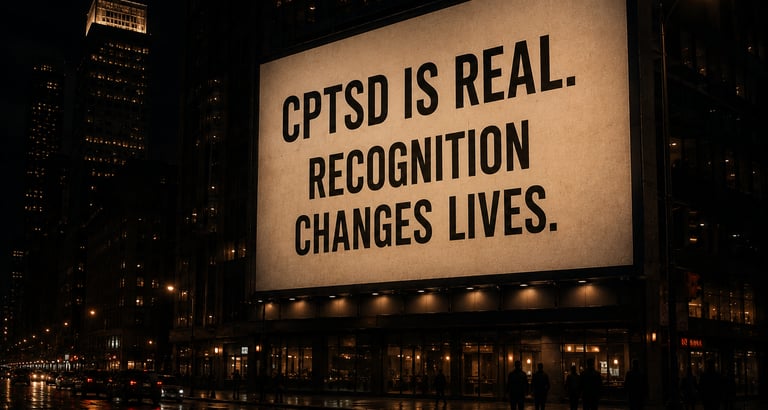
This Educational Website is an awareness program of The Healing and CPTSD Foundation. EIN: 99-2268743
The Healing and CPTSD Foundation is a 501c3 nonprofit organization dedicated to advancing awareness, education, research, and recognition of Complex PTSD. Our educational resources are informed by current trauma research, clinical literature, lived experience, and ongoing community-based data collection.
We do not provide crisis care, crisis intervention or professional therapeutic services. In the event of a crisis, please contact a crisis hotline, local crisis resource, or your healthcare provider immediately. All participants and members are encouraged to seek and maintain appropriate professional care from licensed mental health and medical providers. Our programs provide community-based peer support and are not a substitute for professional therapy or medical treatment. Participation requires that individuals are medically and mentally stable.
Nothing on this website or any associated The Healing and CPTSD Foundation website or platform, is a replacement for or supersedes the direction of your medical or mental health provider, nor is anything on this or any associated The Healing and CPTSD Foundation website or platform a diagnosis, treatment plan, advice, or care for any medical or mental health illness, condition, or disease.
The content provided is for informational and educational purposes only and is not intended to replace professional guidance from your healthcare providers. The Healing and CPTSD Foundation disclaims all responsibility for actions taken based on information provided on this site or through our programs. The Healing and CPTSD Foundation and its affiliates, officers, directors, employees, volunteers, and agents are not liable for any direct, indirect, incidental, consequential, or punitive damages arising out of your use of, or participation in, our programs and website.
Users are solely responsible for their actions and decisions, and should consult with their healthcare providers before making any changes based on the information provided. Mention of specific products, services, or therapists does not imply endorsement by The Healing and CPTSD Foundation. The content is intended for adults 18 years and older. By using our website and programs, you agree to these terms. Please review our Terms and Conditions /Privacy Policy for more information. We reserve the right to update this disclaimer and encourage periodic review.T he Healing and CPTSD Foundation reserves the right to update this disclaimer at any time. Users are encouraged to review it periodically for any changes.
COMPLEX PTSD